Python Pitfalls: How to Secure Your Code Part 1
Recently I watched a presentation by Alex Brumen aka Brumens who is an ethical hacker, developer, bug bounty hunter, and currently a researcher enablement analyst at YesWeHack. Brumens gave a presentation and wrote an article on python’s pitfalls and how to ethically exploit them. In this post we’ll be using code snippets similar to those in Brumen’s article and showcase how we can secure them to prevent these pitfalls. I would highly recommend you watch Brumen’s presentation or read the article linked above.
os.path.join
In VFX software development we used os.path.join often and I noticed in testing that supplying an absolute path would ignore previous paths used in the function. As Brumen showcases in his article looking at the documentation for os.path.join it states that exact issue:
If a segment is an absolute path (which on Windows requires both a drive and a root), then all previous segments are ignored and joining continues from the absolute path segment.
Here is an example of a piece of vulnerable code that uses os.path.join.
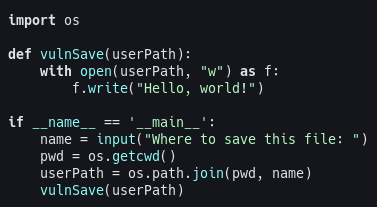
So looking at our code example we give the user the option to supply a name to save a file that will write “Hello, world!” to a location on disc. Due to the fact that we’re using os.path.join to join the pwd to the supplied file name by the user we are able to exploit it to save the file to any location on disc as shown in the screenshot below.
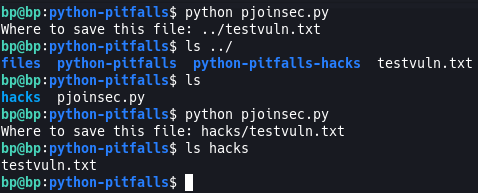 The folder
 hacks is a symlink to the folder python-pitfalls-hacks one directory back.
As you can see due to the use of os.path.join we were able to do path traversal to save the file one directory up from where the file should have been saved to. This means we would be able to save this file anywhere, assuming this code is called as sudo. One way this could be used maliciously is if a website or application allows the user to save a file on the server and the developer used an unsanitized os.path.join call, the user could then craft a cron file and upload it to /etc/cron.d/filename to get the malicious code to run as a cron job by the system.
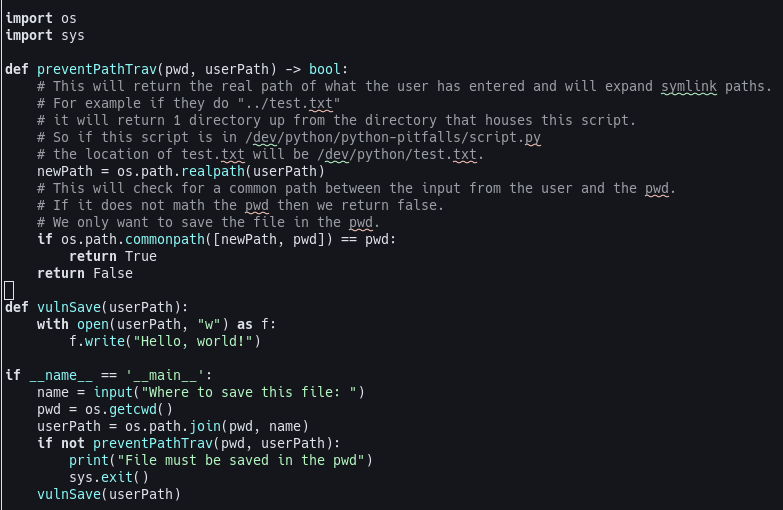
So how can we prevent this? Well, I’m sure there are a few ways to secure your code, but I’m going to show you the approach I take to secure the os.path.join call to prevent malicious attacks. In this code all we’re doing is getting the absolute path of the file name, or in this case, the location the user is trying to save the file to, and then we’re checking the common path and making sure it equals the pwd of where the script is called from.
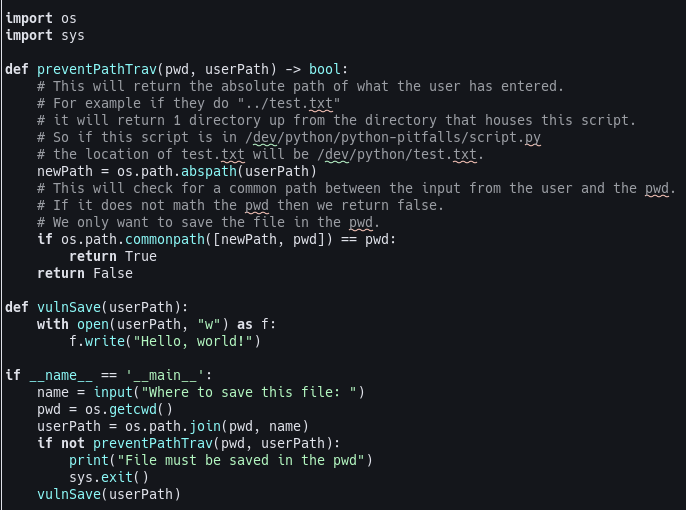
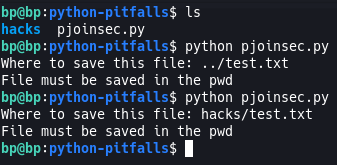
This method does have 1 pitfall with folders that are symlinks. If the directory we’re saving the file in has a symlink to another folder elsewhere on the system then this method would still allow us to write to that symlinked location and could be vulnerable. Using the code above we can replace os.path.abspath(userPath) with os.path.realpath(userPath) and that will resolve all symlinks to a real existing canonical path. With that change this is the new code:
pathlib.joinpath
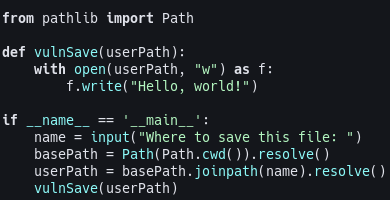
The pathlib.joinpath function is similar to os.path.join where calling it will append each provided argument in sequence. Here is a piece of vulnerable code, keeping it in line with what we used for os.path.join:
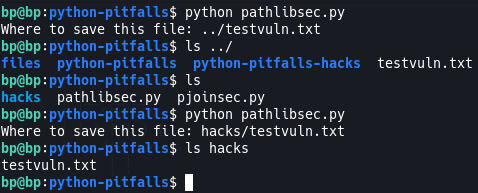 The folder
 hacks is a symlink to the folder python-pitfalls-hacks one directory back.
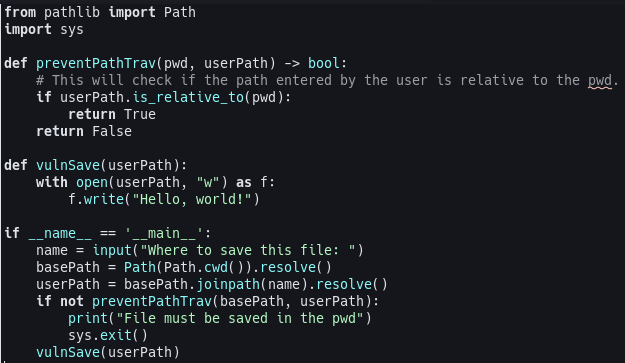
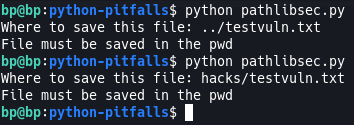
In the os.path.join example we used os.path to secure our code, so for this example I’m going to stick to pathlib.Path to secure our code. With that in-mind we have to change our code a bit to get appropriate paths to test against. The first call we’re making is to resolve(). When we call Path.joinpath or create a Path object we call resolve() to make the path absolute and resolve any symlinks in the process. Then we use a function to check if the path we’ve resolved is relative to the pwd using Path.is_relative_to(pwd). So the secure code will be:
This ends the first part of Python Pitfalls: How to Secure Your Code. These functions are widely used in python projects and could be easily exploited by bad actors so knowing how to secure your code is vital to prevent it. Make sure to always read the documentation of functions you’re using in production code!